[프롤로그] 광한루원과 요천 — 사랑의 누각에 묻힌 1597년의 비명
프롤로그: 광한루원과 요천 — 사랑의 누각에 묻힌 1597년의 비명
위치: 전북특별자치도 남원시 요천로 1447 (천거동) 광한루원 및 요천 일원 (N 35°24'15" · E 127°22'45")
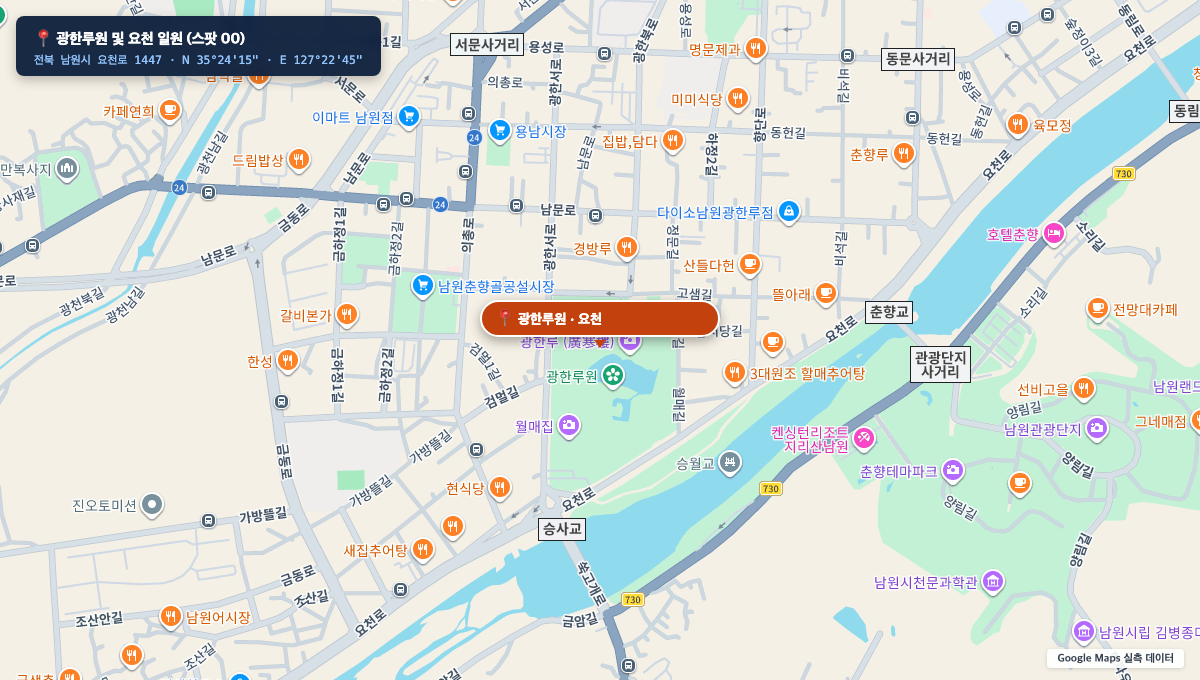
▲ [현대 위치도] Google Maps 기반 광한루원 및 요천 일원 현대 좌표
시대 배경: 조선 세종 1년(1419년) 창건 / 1461년 장의국 정비 / 1582년 송강 정철 삼신산 조성 / 1597년(선조 30년) 음력 8월 정유재란 전초전
주요 인물: 성춘향과 이몽룡, 명나라 총병 양원(楊元), 접반사 정기원(鄭期遠), 남원부사 임현(林鉉), 전라병사 이복남(李福男), 왜군 총대장 우키타 히데이에(宇喜多秀家)
1. 싱그러운 신록의 누각과 춘향·몽룡의 운명적 사랑
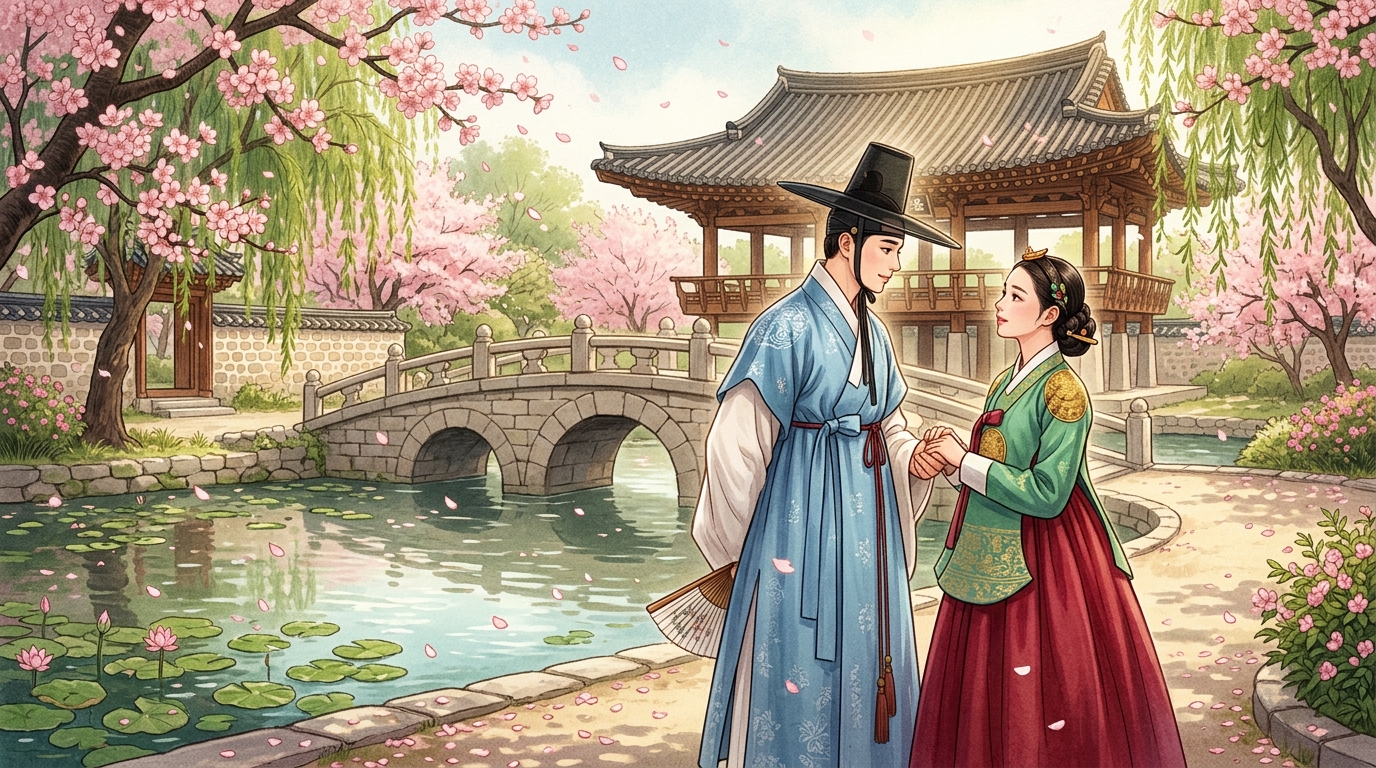
▲ [문학 예술 삽화] 광한루원 오작교 기슭에서 마주 선 성춘향과 이몽룡 — 초여름 신록이 싱그러운 단옷날, 맑은 연못과 웅장한 광한루를 배경으로 서로를 마주 보며 영원한 사랑을 약조하는 두 청춘의 애틋하고 눈부신 순간을 형상화한 예술적 재현입니다.
신록이 우거지는 계절, 지상에 펼쳐진 천상의 정원
남원의 정원은 계절마다 눈부신 자태를 뽐냅니다. 지리산 만복대와 노고단에서 발원한 시원한 바람이 남원 분지를 쓰다듬고, 도심을 가로지르는 요천 강둑을 따라 푸른 물결이 흐르면 남원은 맑은 생명력으로 가득 찹니다. 그 요천 북쪽 언덕에 자리한 조선 최고의 정원, 광한루원(廣寒樓苑, 명승 제56호)은 신록이 짙어갈 때 가장 웅장하고 그윽한 자태를 드러냅니다.
수양버들이 연못 수면에 길게 그림자를 드리우고, 맑은 바람이 수면을 스치며 잔물결을 일으키는 정원. 그 한가운데 우뚝 솟은 보물 광한루(寶物 廣寒樓)는 단순한 정자가 아니라, 조선인들이 꿈꾸었던 우주와 천상의 세계를 지상에 옮겨놓은 '달나라 옥황상제의 궁전(광한청허부·廣寒淸虛府)'입니다.
"바람결에 그네가 오르내리니..." — 두 청춘의 눈맞춤
조선 후기 민중들의 가슴을 울린 불후의 고전 소설 《춘향전(春香傳)》의 무대가 바로 이곳입니다. 때는 녹음이 짙어가는 음력 오월 단오(端午) 날. 남원부사의 총명한 자제 이몽룡은 책장을 덮고 방자(房子)를 앞세워 초여름 풍경을 구경하러 광한루에 올랐습니다.
누각 난간에 기대어 바람을 쐬던 몽룡의 시선이 연못 너머 숲속에서 멈추었습니다. 벽공(碧空)을 차고 오르는 한 폭의 비단결 같은 그네, 그리고 그 위에 올라탄 꽃다운 열여섯 살 처녀. 싱그러운 버들잎이 흩날리는 푸른 숲 사이로 붉은 치마폭을 펄럭이며 허공으로 날아오르는 성춘향의 눈부신 자태는 몽룡의 시선을 단번에 사로잡았습니다.
방자를 불러 누각 아래로 안내를 청한 몽룡은 요천의 물소리가 잔잔히 울려 퍼지는 오작교 기슭에서 춘향과 마주 섰습니다. 수줍게 고개를 숙인 채 옷깃을 만지는 춘향, 그리고 그 앞에 가슴 벅찬 숨을 삼키며 다가선 몽룡. 두 사람은 조심스럽게 서로의 손을 맞잡았습니다. 신분과 제도의 벽을 뛰어넘어 목숨까지 바치며 지켜낸 지고지순한 사랑의 서사가 바로 이 유서 깊은 정원에서 시작된 것입니다.
2. 지상에 구현된 천상의 우주 — 광한루원 경내 입체 안내
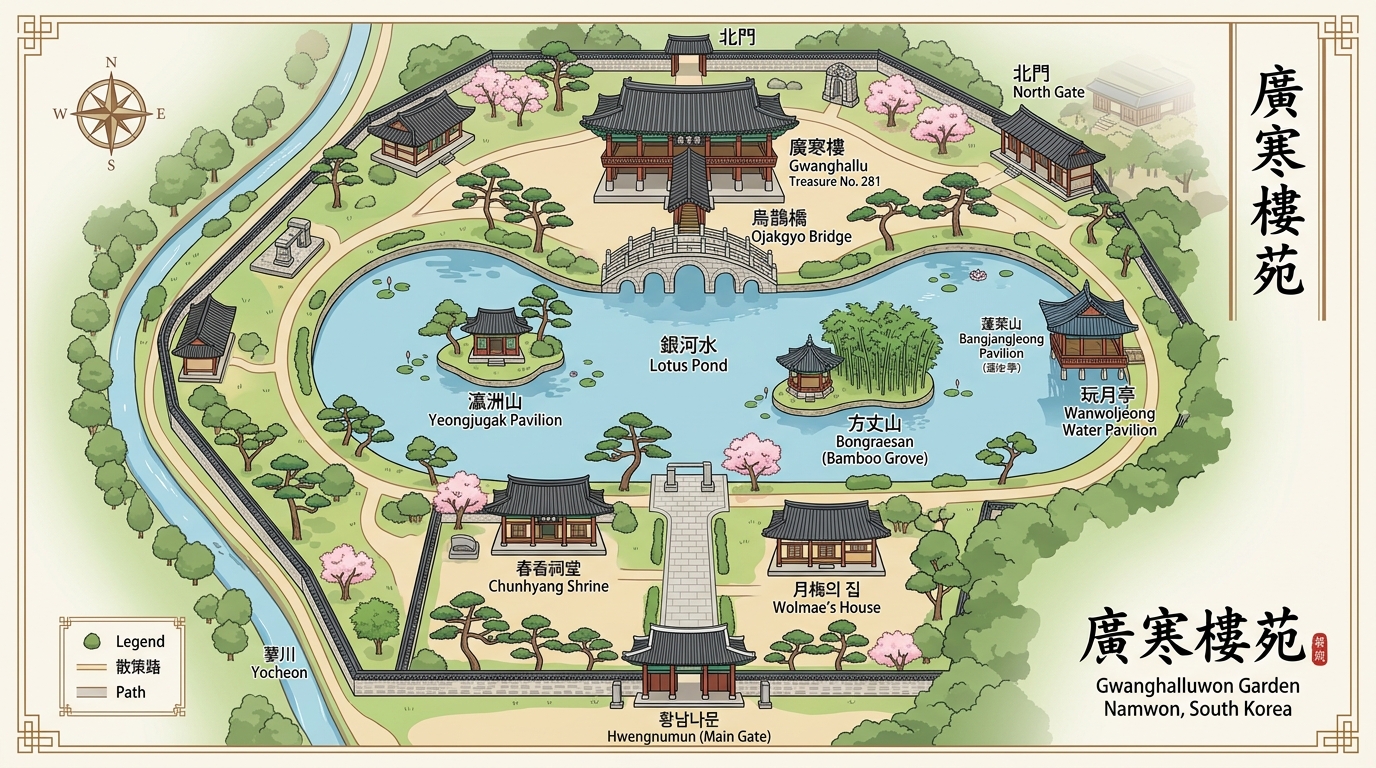
▲ [경내 입체 조감도] 광한루원 안내도(Gwanghallu Garden Guide Map) — 남쪽의 요천 수계를 끌어들여 은하수 호수를 만들고, 삼신산(영주·봉래·방장)과 오작교, 본루인 광한루, 완월정, 춘향사당, 월매집을 유기적으로 배치한 천상 우주 정원의 조감 맵입니다.
광한루원은 1419년(세종 1년) 남원으로 유배 온 황희(黃喜) 정승이 '광통루(廣通樓)'를 짓고 풍류를 즐긴 것에서 출발했습니다. 이후 1444년 전라도관찰사 정인지가 그 수려한 경치를 보고 "달나라 옥황상제가 사는 광한청허부(廣寒淸虛府)가 바로 이곳이로구나" 감탄하며 광한루(廣寒樓)라 개칭하였습니다. 이어 1461년(세조 7년) 남원부사 장의국(張義國)이 요천 물을 끌어들여 거대한 은하수 호수를 파고 네 개의 홍예를 튼 돌다리 오작교를 처음 축조하였습니다. 훗날 1582년(선조 15년) 전라관찰사로 부임한 송강 정철(鄭徹)이 연못 안에 영주·봉래·방장의 삼신산(三神山)을 조성하고 수목을 식재하면서 지상에 구현된 완전한 천체 우주 정원으로 완성되었습니다.
광한루원 핵심 공간 탐방 가이드
- 광한루 (보물 제281호):
정면 5칸, 측면 4칸의 웅장한 팔작지붕 2층 누각입니다. 뒤편에는 누각으로 오르는 아름다운 목조 계단 차양이 독특한 곡선을 자랑하며, 호남 제일의 명루로서 수많은 시인 묵객들이 남긴 명문 편액들이 걸려 있습니다. - 연못과 삼신산 (三神山: 영주산·봉래산·방장산):
도교의 신선들이 산다는 세 개의 신선 섬을 연못 한가운데 띄웠습니다. 영주산에는 영주각(瀛洲閣), 방장산에는 방장정(方丈亭)을 세우고, 봉래산에는 푸른 수목을 심어 지상에서 신선계를 노니는 이상향을 조경학적으로 구현했습니다. - 오작교 (烏鵲橋):
천상의 은하수에 가로막힌 견우와 직녀가 칠월칠석에 만난다는 전설의 무지개다리로, 1461년 장의국이 처음 놓은 후 1582년 정철의 삼신산 정비와 더불어 오늘날까지 이어져 온 한국 전통 석교의 걸작입니다. - 완월정 (玩月亭):
동쪽 호수 위에 날아갈 듯 세워진 수중 누각으로, 달맞이를 즐기던 선비들의 풍류가 서린 곳이자 오늘날 남원 춘향제의 주요 무대로 활용되고 있습니다. - 춘향사당과 월매집:
성춘향의 굳은 지조를 기리는 춘향사당과, 몽룡과 춘향이 사랑의 백년가약을 맺던 고택을 재현한 월매집이 정원 일대에 자리하여 문학적 정취를 더합니다.
3. 오작교(烏鵲橋)의 유래와 비보풍수 거북 석상
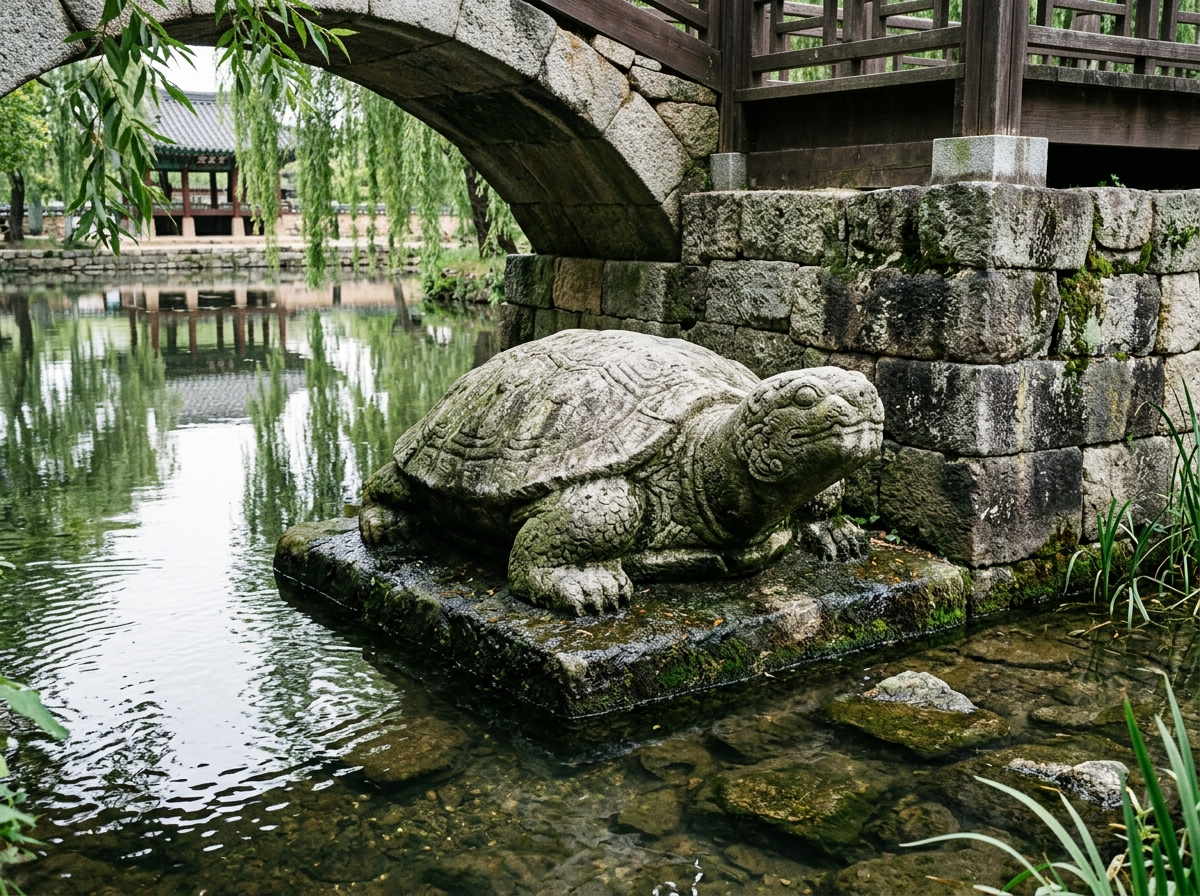
▲ [박물관 유물 도판] 광한루 오작교 수로 일대에 세워진 석조 거북 지신(地神) — 요천의 물길을 끌어들여 연못을 정비하는 과정에서 남원 분지의 화기(火氣)를 다스리고 고을의 평안을 기원하기 위해 세운 비보풍수(裨補風水) 석조물. 1597년 정유재란 당시 광한루 일원이 병화를 입는 참화 속에서도 살아남아 역사의 변천을 묵묵히 지켜보고 있습니다.
1. 오작교의 역사와 문학적 상징
광한루 앞 호수를 가로지르는 오작교(길이 약 57m, 폭 2.4m)는 한국 전통 정원 연못에 놓인 석교 중 가장 유서 깊은 다리 중 하나입니다. 《춘향전》에서 춘향과 몽룡이 사랑을 확인한 무대로 널리 알려지며, 수백 년간 연인들이 영원한 신뢰와 화합을 약조하는 상징적 공간으로 자리잡았습니다. 네 개의 무지개 홍예문 사이로 맑은 물과 물고기 떼가 노닐고, 물결에 비친 누각의 반영이 흔들리는 풍경은 한국 전통 정원 조경의 백미입니다.
2. 화기(火氣)를 다스리는 비보풍수 거북 석상
오작교 북쪽 호숫가에는 연못 물속을 묵묵히 응시하고 있는 화강암 거북 석상을 만날 수 있습니다. 남원은 지리산 자락의 거센 화기(火氣)가 도심으로 미치는 지형으로 해석되기도 하여, 예로부터 화재를 예방하고 고을의 안녕을 지키기 위해 물을 다스리는 상징물인 거북을 물길 머리에 배치했습니다. 이는 요천의 수계를 지혜롭게 끌어들여 자연과 조화를 이루고자 했던 선조들의 비보풍수 지혜를 잘 보여줍니다.
4. 역사의 충격적 반전 — 사랑의 누각에 들이닥친 1597년의 비명
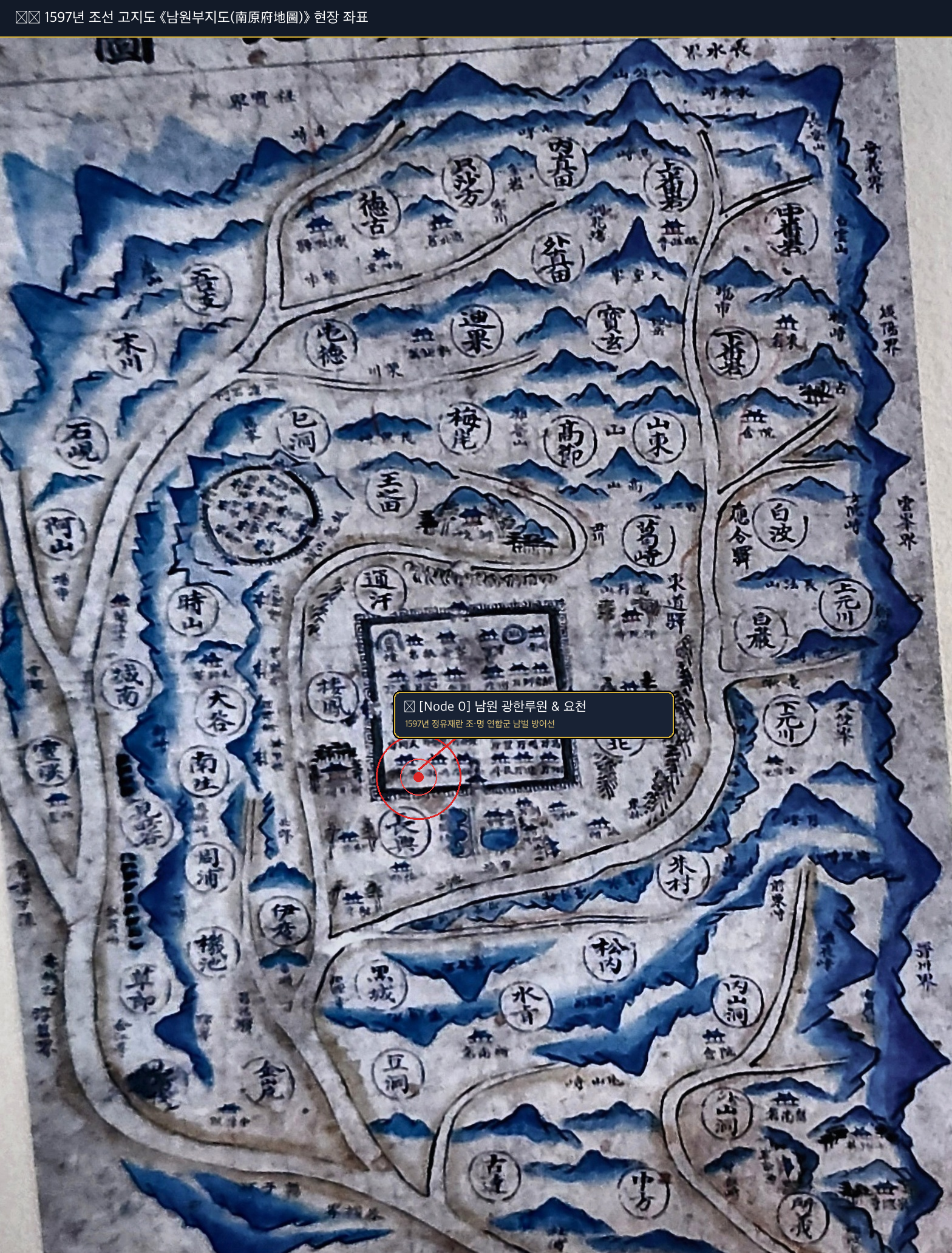
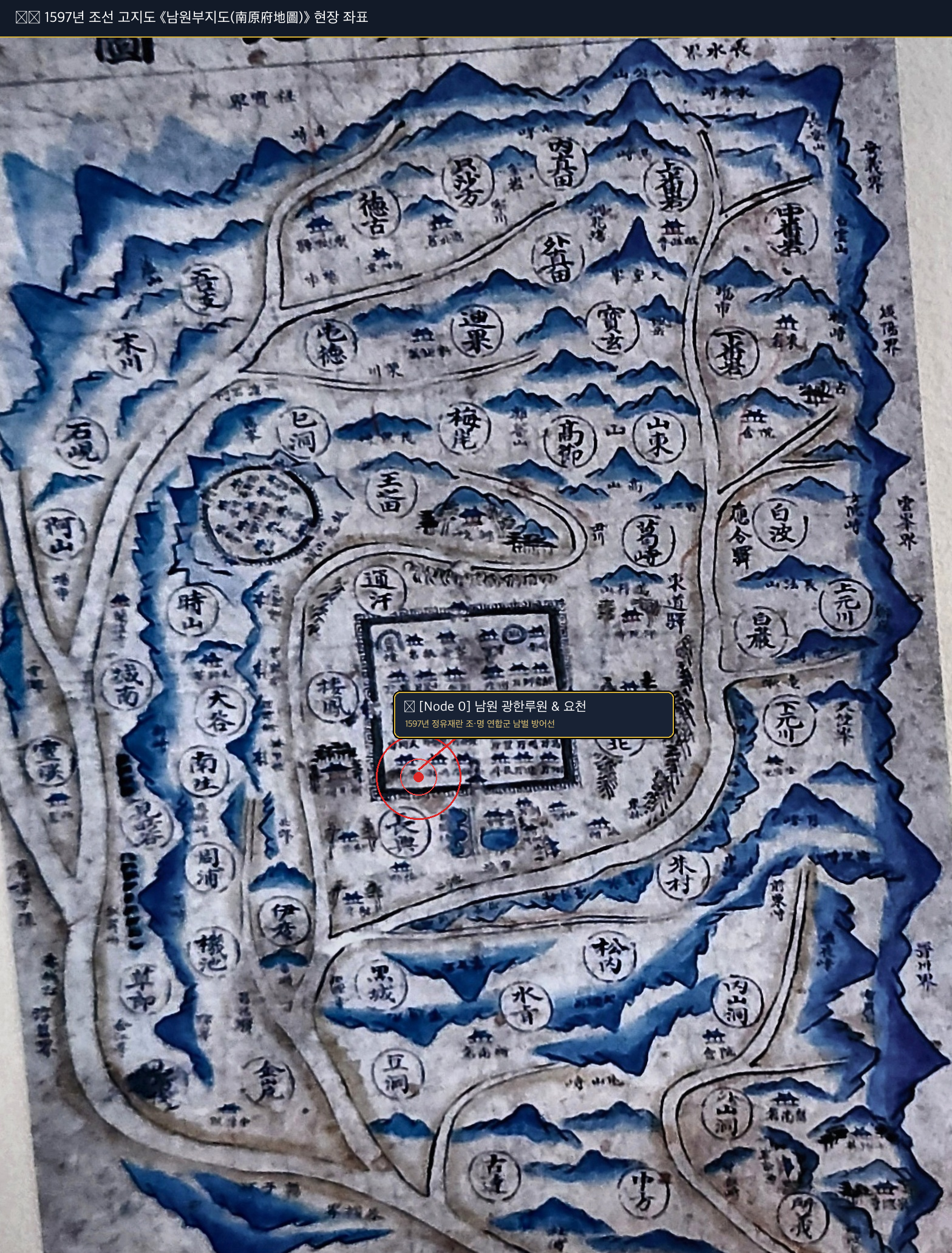
▲ [스팟 00 현대 위치 안내도] 남원 도심 정밀 지도와 광한루원·요천 거점 — 광한루원(오작교·완월정) 경내와 요천 수계 및 도심 도로망을 표시한 위치도입니다. 출발지인 광한루원과 요천 외곽 방어선(스팟 00)에서 북쪽으로 남원읍성 북문 결전지(스팟 01)와 만인의총(스팟 02)으로 이어지는 답사 동선을 안내합니다.
낭만 뒤에 숨겨진 동아시아 국제대전의 격랑
그러나 아름다운 사랑의 노래와 풍류의 무대였던 남원은 정유재란이라는 거대한 전란을 피하지 못했습니다. 1597년(선조 30년) 음력 8월, 우키타 히데이에, 고니시 유키나가, 시마즈 요시히로, 하치스카 이에마사 등이 이끄는 왜군 우군 5만 6천 대군이 호남의 요충지인 남원으로 총집결했습니다.
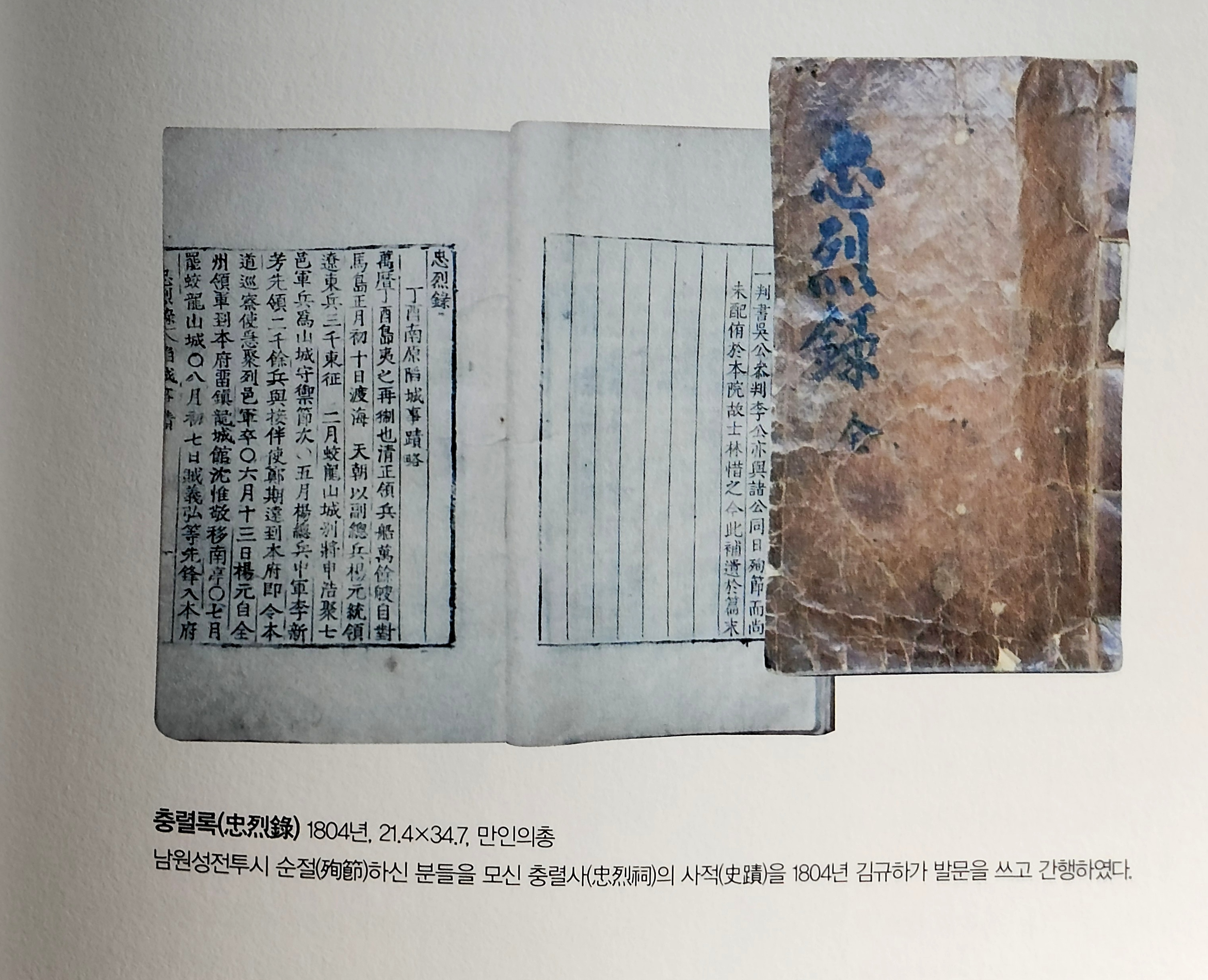
▲ [박물관 유물 도판] 접반사 정기원의 남원 입성 및 순절 기록 《충렬록(忠烈錄)》 — 1597년 남원성 전투에서 순절한 충신들의 사적을 기록한 사료(만인의총 기념관 소장). 명나라 총병 양원과 접반사 정기원(鄭期遠) 등 조·명 지휘부가 남원에 집결하여 작전을 논의했던 역사적 정황을 전합니다.
1. 조·명 연합 지휘부의 전술적 갈등
조선 조정의 요청으로 지원에 나선 명나라 부총병 양원(楊元)은 요동 기병 3,000명을 이끌고 남원에 입성하여 관아와 광한루 일원에 주둔하며 방어 계획을 세웠습니다. 접반사 정기원과 남원부사 임현, 전라병사 이복남 등 조선 측 지휘관들도 남원으로 결집했습니다.
당시 조선 측에서는 사방이 트인 평지 읍성보다 험준한 산악 요새인 교룡산성(蛟龍山城)으로 들어가 좁은 협곡을 지키며 장기 수성전을 펼쳐야 한다는 의견을 제기했습니다. 그러나 요동 기병의 평지 기동전과 화포 화력을 맹신했던 양원은 산성 입보 의견을 받아들이지 않고 남원읍성 방어를 고수했습니다. 이 전술적 교리 충돌로 인해 조·명 연합군과 성안의 군민들은 평지 읍성에서 5만 6천 대군의 포위망을 맞닥뜨리게 되었습니다.
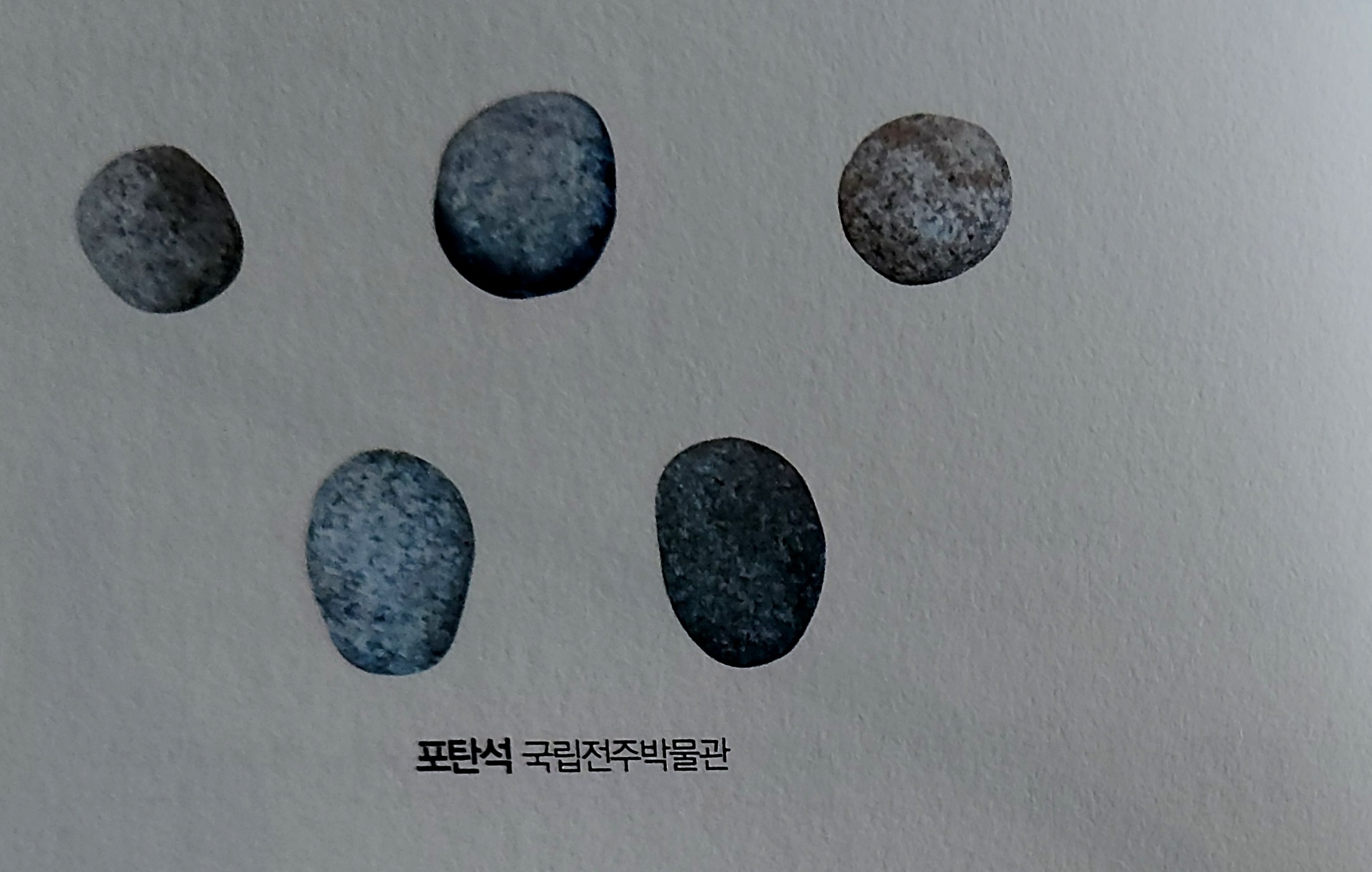
▲ [박물관 유물 도판] 남원성 성벽 방어용 대형 포탄석(石丸·포환) 유물 — 요천 및 남원읍성 일대 격전지 토층에서 수습된 조선군 화포 장전용 포탄석(국립전주박물관 소장). 조총 부대로 밀려드는 왜군에 맞서 남원 군민들이 결사적으로 방어전을 치렀던 유물입니다.
2. 8월 12일 밤, 핏빛으로 물든 요천의 격전
음력 8월 12일 저녁, 왜군 선발대가 요천 건너편에 집결하여 수많은 횃불을 밝히며 남원성을 압박하기 시작했습니다. 평화롭게 흐르던 요천은 적의 도하를 막아서는 남쪽 외곽의 천연 해자 역할을 하였고, 강변 일대에서는 치열한 전초전이 벌어졌습니다.
왜군은 요천 수계를 우회하고 차단하며 읍성 외곽을 포위했고, 민가의 볏짚단을 대량으로 베어 참호와 해자를 메우며 접근해 왔습니다. 격전 속에서 광한루의 본래 누각 또한 화마를 입어 소실되고 말았습니다. 비록 건물은 잿더미가 되었으나, 오작교와 석조 거북상은 400년 넘는 세월을 견디며 당시의 아픈 역사를 오늘에 전하고 있습니다.
5. 스토리텔링 8컷 만화 릴스 — 광한루원에 서린 1597년의 비명
8컷 역사 만화로 읽는 역사의 이면: 왜 '사랑의 정원'에서 비극을 응시해야 하는가?
본 8컷 역사 만화는 대중에게 익숙한 《춘향전》의 낭만적 무대 광한루원이 실은 1597년 동아시아 국제대전의 가장 비장한 전시사령부였다는 극적인 역사적 진실을 청소년과 현대 독자들의 눈높이에 맞추어 복원하기 위해 기획되었습니다.
- 서사적 대비와 시간의 교차 (1~3컷): 화창한 봄날 오작교 위를 거닐며 춘향의 사랑을 떠올리는 꼬마 선비 마스코트의 평화로운 시선으로 시작합니다. 그러나 지리산에서 불어오는 강바람과 함께 수면이 일렁이며, 400년 전 음력 8월 12일 밤 왜군 5만 6천 대군이 밝힌 붉은 횃불의 바다로 시공간이 급변합니다. 아름다운 연못이 곧 피비린내 나는 전장으로 뒤바뀌는 시각적 충격은 독자에게 평화의 소중함을 직관적으로 일깨웁니다.
- 지휘부의 고뇌와 전략적 비극 (4~6컷): 광한루 누각 위에서 작전 회의를 주재하는 명나라 총병 양원과 조선의 충신 임현·정기원·이복남의 대립을 조명합니다. 험준한 교룡산성으로 들어가 결전하자는 조선 장수들의 혜안을 묵살한 양원의 오만, 그리고 요천 강변이 왜군의 조총 사격과 불화살로 화염에 휩싸이는 파국을 역동적인 필치로 묘사했습니다. 오작교 아래 물길을 지키던 석조 거북 지신마저 잿더미 속에서 눈물을 흘리는 연출은 문화유산에 깃든 역사의 아픔을 감성적으로 전달합니다.
- 순례자의 자각과 영원한 교훈 (7~8컷): 마지막 장면에서 꼬마 선비는 다시 현대의 고요한 광한루원으로 돌아와 엄숙하게 옷깃을 여밉니다. "우리가 누리는 이 평화 뒤에는 400년 전 그분들의 거룩한 피가 흐르고 있었구나..."라는 독백은, 오늘날 우리가 딛고 선 일상의 평온이 결코 저절로 얻어진 것이 아니며 1만여 무명 영웅들의 희생 위에 세워진 거룩한 유산임을 가슴 깊이 새기게 만듭니다.
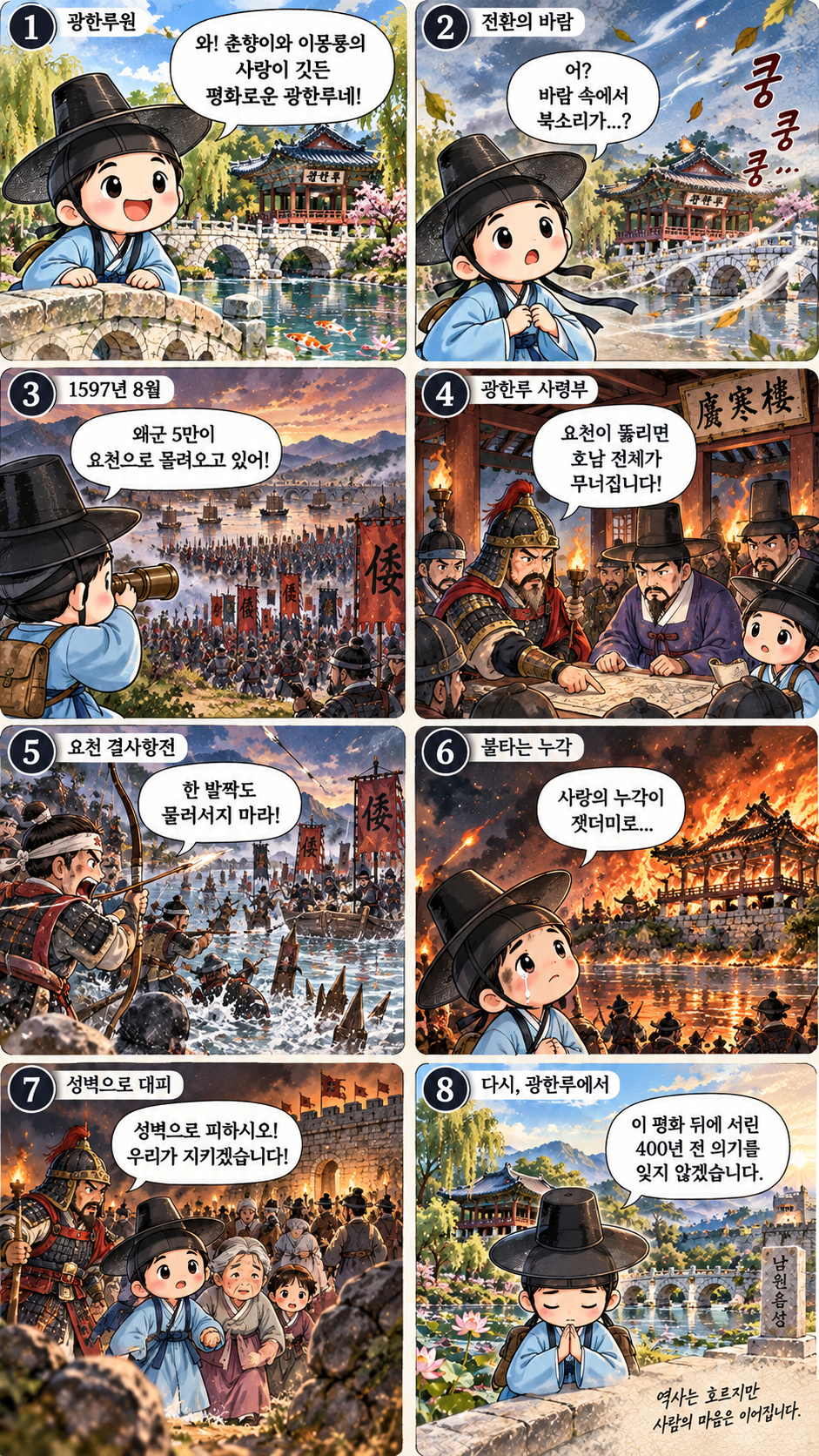
▲ [8컷 만화 릴스] 프롤로그: 사랑의 누각에서 전시사령부로, 핏빛 요천의 비극
6. 다음 스팟으로의 링크 및 답사 동선 심층 가이드
요천 외곽 방어선에서 포위된 평지읍성으로 — 500m의 순례길이 갖는 전략적 의미
광한루원과 요천 일원의 답사를 마친 여행자는 이제 왜군과 조·명 연합군이 마주했던 제1차 저지선을 뒤로하고, 결전의 본무대였던 [제1장: 핏빛 남원읍성]으로 발걸음을 옮겨야 합니다.
- 도보 순례 동선 (남에서 북으로 500m):
광한루원 북문(완월정 방면)을 나와 남원 도심을 관통하는 간선도로(옛 남원도호부 관아 거리)를 따라 북쪽으로 약 500미터(도보 7~8분) 직진하면, 나흘 밤낮 1만여 군민이 뼈를 묻은 거대한 평지 석성 남원읍성의 복원된 성벽과 마주하게 됩니다. - 전투 전개의 필연적 서사 연속성:
왜 광한루와 요천을 본 뒤 반드시 남원읍성으로 이어져야 하는가? 1597년 음력 8월 12일부터 13일까지 펼쳐진 전투는 외곽 수계인 '요천'을 사이에 둔 공방전이었습니다. 왜군 5만 6천 명이 요천의 물길을 끊고 백사장을 건너 광한루를 비롯한 외곽 민가를 모조리 불태우자, 외곽을 방어하던 군사들과 남원 분지의 1만여 백성들은 더 이상 물러설 곳이 없어 사각형 평지 석성인 '남원읍성' 안으로 쫓겨 들어갔습니다. - 현장 답사 팁 (역사적 상상력의 확장):
광한루에서 읍성으로 걸어가는 이 500미터의 길은 단순한 산책로가 아닙니다. 400여 년 전 화염에 휩싸인 누각을 뒤로하고 왜군의 조총 탄환이 빗발치는 가운데 어린아이와 노부모의 손을 잡고 읍성 성문 안으로 숨 가쁘게 철수해야 했던 남원 백성들의 '마지막 피난길'이었습니다. 요천의 탁 트인 강바람이 사라지고 성벽의 묵직한 돌무더기가 시야를 가로막는 순간, 독자는 1만여 영혼들이 감당해야 했던 숨 막히는 고립감과 결사의 투혼을 온몸으로 실감하게 될 것입니다.
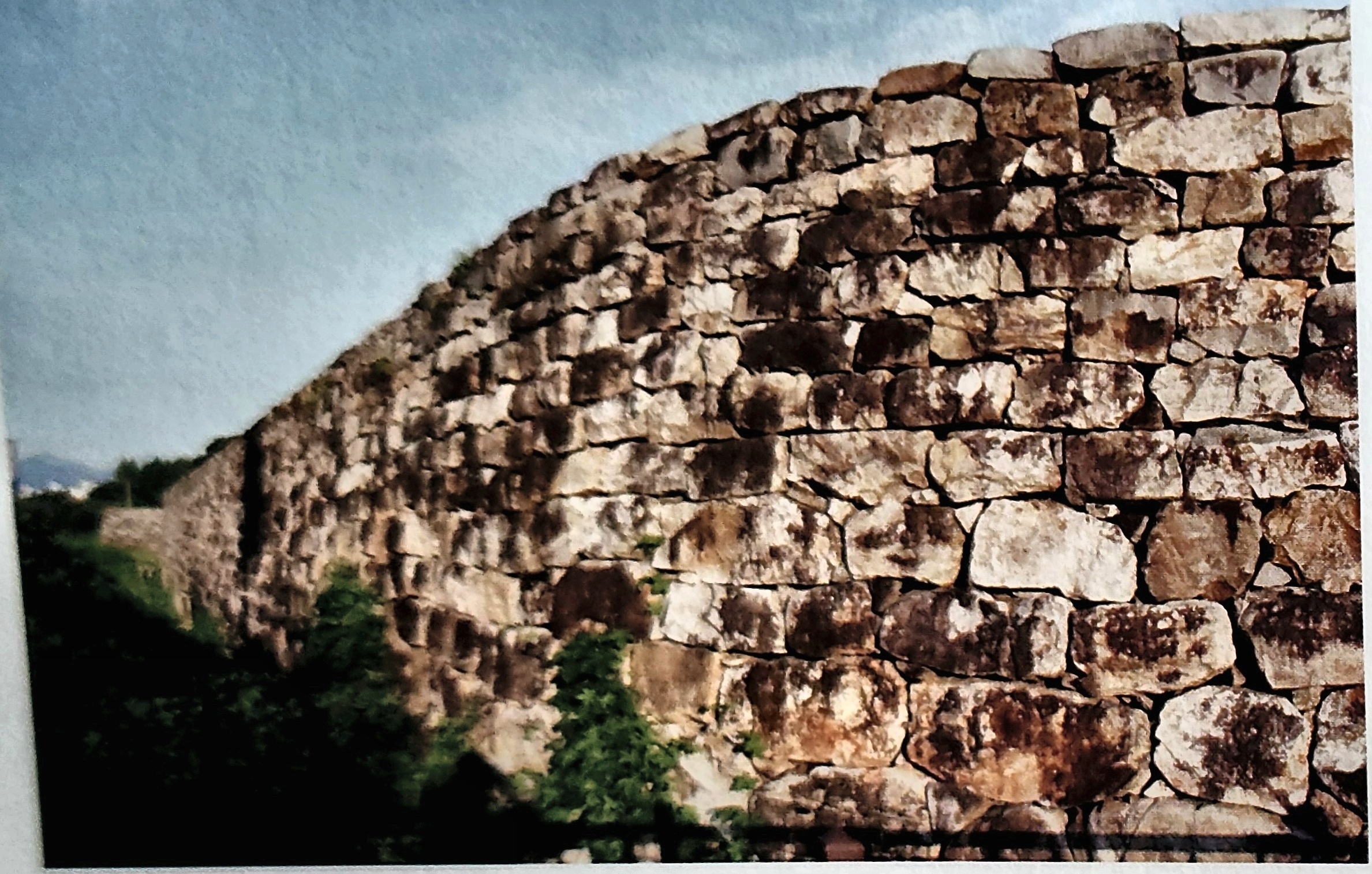
▲ [다음 행선지 답사 유적] 500m 순례길 끝에서 마주하는 남원읍성(사적 제298호) 복원 성벽 — 광한루와 요천 외곽 방어선에서 후퇴한 1만여 군관민이 왜군 5만 6천 명의 포위망에 맞서 나흘 밤낮 결사항전을 벌였던 역사의 현장입니다. 발굴된 기초 석축 위에 복원된 이 성벽은 다음 장에서 이어질 처절한 혈전의 무대이자, 민족의 뼈아픈 수난과 불굴의 의기를 증언합니다.
[Prologue] Gwanghallu Pavilion & Yocheon Stream — The Screams of 1597
Prologue: Gwanghallu Pavilion & Yocheon River — Screams of 1597 Beneath the Pavilion of Love
Location: 1447 Yocheon-ro, Namwon-si, Jeonbuk State (Gwanghallu & Yocheon River Basin) (N 35°24'15" · E 127°22'45")
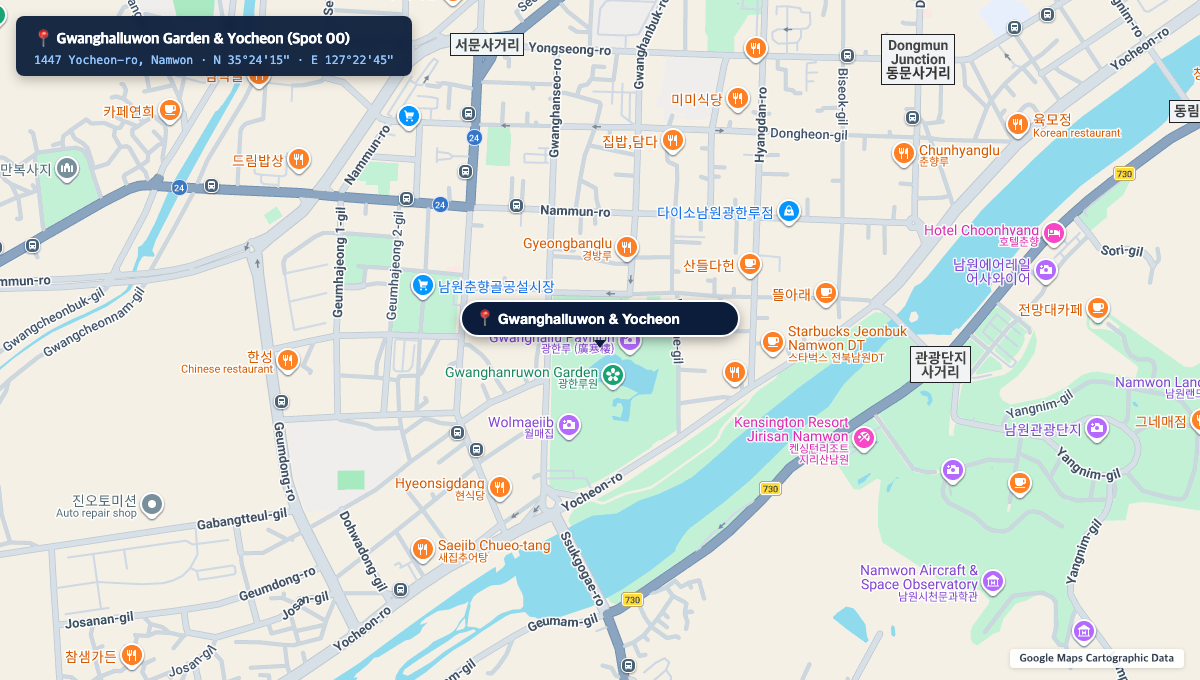
▲ [Field Map] Cartographic Layout of Gwanghalluwon Garden & Yocheon River Basin (Google Maps)
Historical Era: Founded in 1419 (1st year of King Sejong) / Expanded in 1582 by Jeong Cheol / August 1597 Japanese Reinvasion
Key Figures: Seong Chunhyang & Yi Mongryong, Ming General Yang Yuan, Royal Envoy Jeong Gi-won, Namwon Magistrate Lim Hyeon, Joseon Provincial Commander Yi Bok-nam, Japanese Right Army Commander Mori Hidemoto
1. Fluttering Cherry Blossoms & The Immortal Romance of Chunhyang and Mongryong
▲ [Literary Fine Art Illustration] Seong Chunhyang and Yi Mongryong Hand in Hand beneath Fluttering Cherry Blossoms at Gwanghalluwon — On a radiant spring morning as soft pink cherry blossom petals drift down like gentle rain, the two young lovers gaze tenderly into each other's eyes before the tranquil pond and majestic pavilion, pledging eternal love.
A Heaven on Earth: The Spring Splendor of Gwanghalluwon
Spring in Namwon arrives with breathtaking poetry. As balmy breezes blow down from the towering peaks of Mount Jirisan—Manbokdae and Nogodan—they sweep gently across the fertile Namwon Basin. Along the embankments of the Yocheon River that courses through the heart of the city, thousands of cherry trees burst into blossom in unison, draping the town in a cloud of luminous white and pink. On the northern banks of this river rests Gwanghalluwon Garden (Scenic Site No. 56), the crowning jewel of classical Korean landscape architecture, revealing its most enchanted splendor when petals rain across the waters.
Weeping willows cast graceful emerald reflections upon the mirrored surface of the lotus pond. Each passing gust sends flurries of cherry petals swirling through the crystal-clear sky to rest gently upon the water. At the center of this dreamscape rises the stately Gwanghallu Pavilion (Treasure No. 281)—not merely a wooden pavilion, but an earthly manifestation of the mythical Gwanghan Cheongheobu, the celestial Moon Palace of the Jade Emperor in traditional Taoist cosmology.
"As the Swing Rose into the Spring Air..." — The Fateful Glance
This idyllic garden served as the living backdrop for 《Chunhyangjeon (The Tale of Chunhyang)》, the timeless classic of Korean literature that has stirred hearts for centuries. On the fifth day of the fifth lunar month during the joyous Dano Festival, Yi Mongryong, the gifted young son of the Namwon magistrate, laid down his books and climbed to the second floor of Gwanghallu Pavilion to admire the vernal panorama with his servant Bangja.
Resting against the wooden railing, Mongryong's gaze froze upon a secluded thicket across the pond. High above the greenery, a swing mounted with colorful silk ropes soared into the azure sky, carrying a radiantly beautiful sixteen-year-old maiden. Fluttering through the cherry blossoms with her crimson skirt billowing like a peony in flight, Seong Chunhyang captivated Mongryong's soul in an instant.
Beckoning Bangja to escort him, Mongryong hurried downstairs and encountered Chunhyang beside the four-arched stone Ojakgyo Bridge, where the murmur of Yocheon's watercourses echoed softly. Blushing with downcast eyes as she fingered her jade-green jacket collar, Chunhyang looked up as Mongryong approached with breathless admiration. There, in that sun-dappled glade, they gently joined hands. Transcending strict feudal hierarchy and social barriers, their legendary devotion—destined to withstand torture and prison—began right here within this garden of falling blossoms.
2. Taoist Cosmos on Earth — 3D Guide to Gwanghalluwon Garden
▲ [3D Illustrated Guide Map] Architectural Layout of Gwanghalluwon Garden (Namwon, Korea) — Diverting the pristine streams of the Yocheon River into an artificial Milky Way pond, this garden ingeniously harmonizes the Three Mythical Taoist Islets (Yeongju, Bongrae, Bangjang), the stone Ojakgyo Bridge, the main Gwanghallu Pavilion, Wanwoljeong Water Pavilion, Chunhyang Shrine, and Wolmae's House into a cohesive celestial paradise.
Gwanghalluwon originated in 1419 (the 1st year of King Sejong's reign) when Hwang Hui, one of Joseon's most revered prime ministers, was temporarily exiled to Namwon and constructed a modest pavilion called Gwangtongru. In 1444, Governor Jeong In-ji was so enraptured by its celestial beauty that he renamed it Gwanghallu, declaring: "Verily, this is none other than the Jade Emperor's Moon Palace (Gwanghan-bu)!" In 1582, famed poet-statesman Jeong Cheol expanded the estate, digging a vast pond to represent the heavenly Milky Way and planting the three mythical Taoist islands, thus establishing the complete cosmological masterwork seen today.
Core Architectural Highlights of Gwanghalluwon
- Gwanghallu Pavilion (Treasure No. 281):
A magnificent two-story structure spanning 5 bays in width and 4 bays in depth with an elegant hip-and-gable roof. A distinctive wooden covered staircase adorns its northern rear, while its open second floor preserves poetic calligraphy plaques composed by Joseon's greatest scholars. - The Pond and the Three Mythical Islets (Samshinsan: Yeongju, Bongrae, Bangjang):
Embodying Taoist realms where immortals dwell in search of the herb of eternal youth, three verdant islets float upon the pond. Yeongju Island hosts Yeongjugak Pavilion; Bangjang Island hosts Bangjangjeong; and Bongrae Island features an evergreen grove of bamboo, evoking an earthly Shangri-La. - Ojakgyo Bridge (Magpie Bridge):
The legendary stone rainbow bridge where the star-crossed celestial lovers, the Cowherd (Gyeon-u) and Weaver Girl (Jiknyeo), are said to reunite across the Milky Way once a year. - Wanwoljeong Water Pavilion:
An airy open pavilion suspended gracefully over the eastern lake, where Joseon aristocrats held moon-viewing banquets and where the opening ceremonies of the modern Namwon Chunhyang Festival now take place. - Chunhyang Shrine & Wolmae's House:
Located in the garden's northeastern corner, Chunhyang Shrine honors the steadfast fidelity of Seong Chunhyang, while the faithfully reconstructed thatched residence of her mother Wolmae allows visitors to re-live the scenes of secret vows and folk songs.
3. Legends of Ojakgyo Bridge & The Protective Stone Turtle
▲ [Museum Historical Relic] Joseon Stone Turtle Guardian Beneath Ojakgyo Bridge — A carved granite guardian turtle installed under the bridge foundations during the 1582 expansion led by Governor Jeong Cheol. Conceived as a geomantic talisman to quell fire energy and protect the township waterworks, this ancient stone relic survived the cataclysmic conflagration of August 1597 when the entire pavilion burned down, standing today as a silent witness to four centuries of history.
1. Why Was Ojakgyo Bridge Built, and Why Is It So Famous?
Measuring 57 meters in length and 2.4 meters in width, Ojakgyo Bridge is the longest and most splendid classical stone bridge surviving within a traditional Korean garden pond. When Governor Jeong Cheol redesigned the grounds in 1582, he reasoned: "If Gwanghallu represents the Jade Emperor's celestial palace, then the pond before it is the Silver River of the Heavens (Milky Way). To cross the Milky Way, one must build the Magpie Bridge!" Four graceful semi-circular stone arches (hong-ye) were skillfully raised from granite blocks to carry travelers across the lotus-filled waters.
The bridge has become an immortal sanctuary of romance throughout Korea. Not only did Chunhyang and Mongryong stroll across its arched stones in the literary masterpiece, but enduring Korean folklore promises: "Lovers who cross Ojakgyo Bridge holding hands shall never part, living together in blissful harmony for a hundred years." Giant carp glide gently through the four stone arches, their scales catching the sunlight amidst the shimmering reflections of the ancient pavilion.
2. The Geomantic Guardian: The Granite Turtle Quelling Fire
If one peers closely into the grassy northern bank beside Ojakgyo, a massive granite turtle statue (Seokjo Gu-sin) can be seen staring serenely into the water. Though casual visitors often overlook it, this stone turtle holds the most profound protective secret of Gwanghallu.
According to classical Pungsu-jiri (geomancy), the terrain of Namwon was considered vulnerable to malevolent fire energy (hwagi) rolling westward from the volcanic ruggedness of Mount Jirisan. Such pervasive fire energy was believed to induce catastrophic civic blazes and warfare. To counteract this peril, Joseon scholars sculpted a stone turtle—the sacred water spirit (susin) representing longevity and elemental defense—and positioned it where the diverted waters of the Yocheon River entered the garden pond. This geomantic talisman (bibo pungsu) stood sentinel to quench all flame and safeguard the peace of Namwon Prefecture.
4. A Harrowing Reversal — Screams of 1597 Engulf the Pavilion of Love
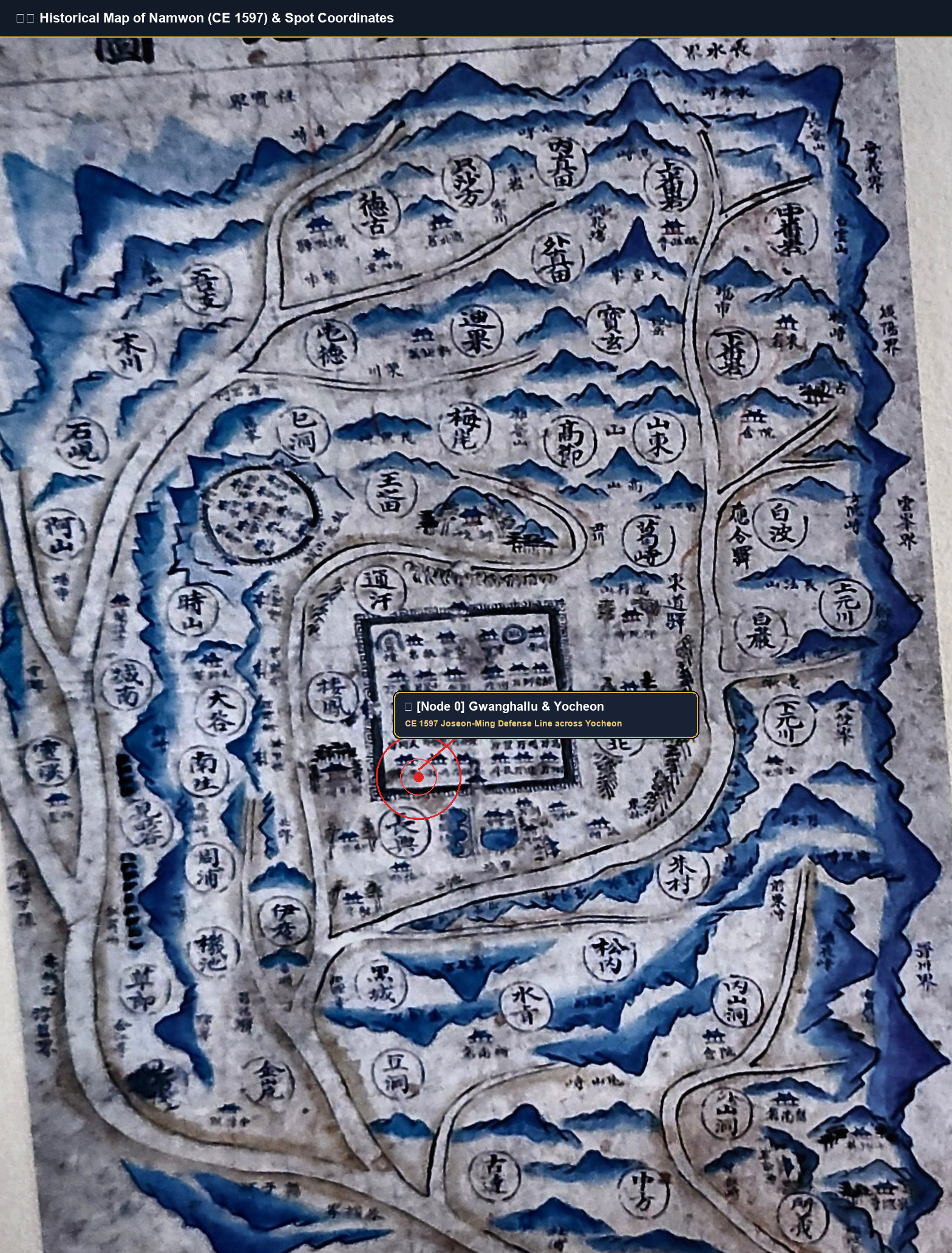
▲ [Spot 00 Modern Cartographic Master Map] High-Detail Downtown Survey Close-up with Gwanghalluwon & Yocheon Target Rings — A precision cartographic survey map zoomed in 200% on Gwanghalluwon Garden, the Yocheon Riverbanks, and downtown avenues. The glowing red concentric target rings highlight the opening pilgrimage site: Gwanghalluwon Garden and the outer defense perimeter (Spot 00). The crimson pilgrimage trace guides visitors clearly along the authentic 500-meter northward route toward the north gate of Namwon Fortress (Spot 01) and the Manin-uichong Martyrs' Shrine (Spot 02).
The Blood-Soaked Reality of an International Conflagration
Yet the songs of romance and pastoral leisure were brutally silenced. In August 1597 (30th year of King Seonjo's reign), merely fifteen years after the expansion of Gwanghalluwon, the garden was suddenly hurled into the vortex of the largest international conflict of early modern East Asia.
Infuriated by his earlier failure to conquer the granary of Jeolla Province, Japanese warlord Toyotomi Hideyoshi commanded his generals to show no mercy: "Trample and conquer Jeolla Province completely. Cut off their noses and salt them as trophies!" A massive invasion force comprising the Japanese Left Army—led by commanders such as Ukita Hideie, Konishi Yukinaga, and Shimazu Yoshihiro—converged upon Namwon, the strategic gatekeeper of the Honam plains.
▲ [Museum Historical Relic] Chronicle of the Martyrs 《Chungnyeolrok (忠烈錄)》 Recording Royal Liaison Jeong Gi-won's Joint Command (1804, Manin-uichong Historical Memorial) — An official archival record published to honor the heroic defenders who fell during the 1597 Siege of Namwon. The opening passage of the text explicitly documents: 'Royal Liaison Jeong Gi-won arrived in Namwon leading 1,000 vanguard troops alongside Ming Commander Li Xinfang, immediately issuing orders to assemble regional militia.' This pristine document records how Jeong orchestrated the joint allied defense from Gwanghallu Pavilion before making his final stand at the northern battlements.
1. Allied War Headquarters at Gwanghallu and General Yang Yuan's Doctrine
In response to Joseon's desperate appeals, Ming General Yang Yuan entered Namwon with 3,000 Liaodong cavalrymen, establishing his battlefield command atop the high, commanding floor of Gwanghallu Pavilion. Royal Liaison Jeong Gi-won, Namwon Magistrate Lim Hyeon, and Provincial Army Commander Yi Bok-nam assembled for urgent war councils.
The Joseon commanders strongly proposed:
"Namwon Fortress is built on flat ground with low ramparts and vulnerable moats. It cannot easily withstand the concentrated matchlock fire and encirclement of an enemy outnumbering us tenfold! We should withdraw into the precipitous mountain bastion of Gyoryongsanseong Fortress (elevation 518m) to conduct an entrenched defense!"
Yet General Yang Yuan insisted on his cavalry and artillery doctrine:
"Withdrawing into rugged mountain crags cripples the mobility of our imperial cavalry and cannons! We shall meet and repel the enemy from the fortified flat ground!"
Due to strategic disagreement and Ming command authority, the allied forces remained at the flatland fortress, where thousands of allied soldiers and civilians were soon surrounded by the advancing Japanese army.
▲ [Museum Historical Relic] Heavy Granite Artillery Projectiles (Stone Shot) — Authentic stone cannonballs unearthed from the battle layers of Namwon Fortress and the Yocheon River basin (Jeonju National Museum). Fired from Cheonja and Jija heavy bronze siege cannons, these spherical stone rounds were designed to smash approaching enemy earthen ramparts and fascines, testifying to the allied defenders' heroic resistance until the final grain of powder was spent.
2. The Night of August 12: A River Turned to Blood
As darkness fell on the 12th day of the eighth lunar month, the vast fields across the Yocheon River were swallowed by a terrifying sea of crimson torches. Descending like a tidal wave from the valleys of Mount Jirisan, 56,000 Japanese warriors encircled the riverbanks and Gwanghallu, unleashing continuous volleys of arquebus fire.
The tranquil stream became the allied defenders' final moat. Its reed beds turned into an apocalyptic slaughterhouse choked with black powder smoke, whistling arrows, and desperate hand-to-hand combat. Japanese engineers diverted the river's flow to sever the town's water supply, while bundles of harvested rice stalks were piled high to bridge the trenches and scale the fortress walls.
Flames quickly engulfed Gwanghallu, reducing the majestic wooden pavilion to smoldering ash. Yet through the inferno, the stone arches of Ojakgyo and the ancient granite turtle survived beneath the soot, silently bearing witness to the unutterable sacrifice of 1597.
5. Storytelling 8-Panel Comic Reel — Screams of 1597 Beneath Gwanghallu
Behind the 8-Panel Comic Reel: Confronting Tragedy within the 'Garden of Love'
The 8-panel storytelling comic reel was conceived to bridge the cognitive divide between popular romantic folklore and harsh historical reality. To most visitors, Gwanghallu is solely remembered through The Tale of Chunhyang. However, in August 1597, this idyllic garden stood at the bloody vortex of a catastrophic East Asian war.
- Dramatic Juxtaposition & Temporal Rupture (Panels 1–3): The comic begins with our young scholar mascot exploring Gwanghallu on a tranquil spring afternoon, marveling at the carp beneath Ojakgyo Bridge. As river winds gust from Mount Jirisan, the waters ripple, violently dissolving the peaceful present into the horrific night of August 12, 1597. The sudden emergence of 56,000 torchlights across the river basin shatters romantic illusions, immediately immersing modern readers in the imminent terror of total war.
- Commanders' Dilemma & Strategic Catastrophe (Panels 4–6): The narrative turns to the high-stakes council atop Gwanghallu Pavilion. We witness the tragic friction between Ming Commander Yang Yuan and Joseon leaders Lim Hyeon, Jeong Gi-won, and Yi Bok-nam. Rejecting the prudent advice to withdraw to the high ground of Gyoryongsanseong Fortress, Yang Yuan's hubris dooms the garrison to open flatland combat. The panels visually erupt as Japanese arquebus volleys and fire arrows turn Gwanghallu into a roaring inferno, culminating in the poignant image of the stone guardian turtle weeping beneath the ashes of Ojakgyo.
- Pilgrim's Awakening & Enduring Legacy (Panels 7–8): Returning to the peaceful modern garden, the mascot bows his head in profound solemnity: "Beneath the peace we enjoy today runs the sacred blood spilled here four centuries ago..." This conclusion imparts an essential civic truth: freedom and peace are never free gifts of nature, but the hard-won legacy of ten thousand nameless martyrs who refused to surrender.
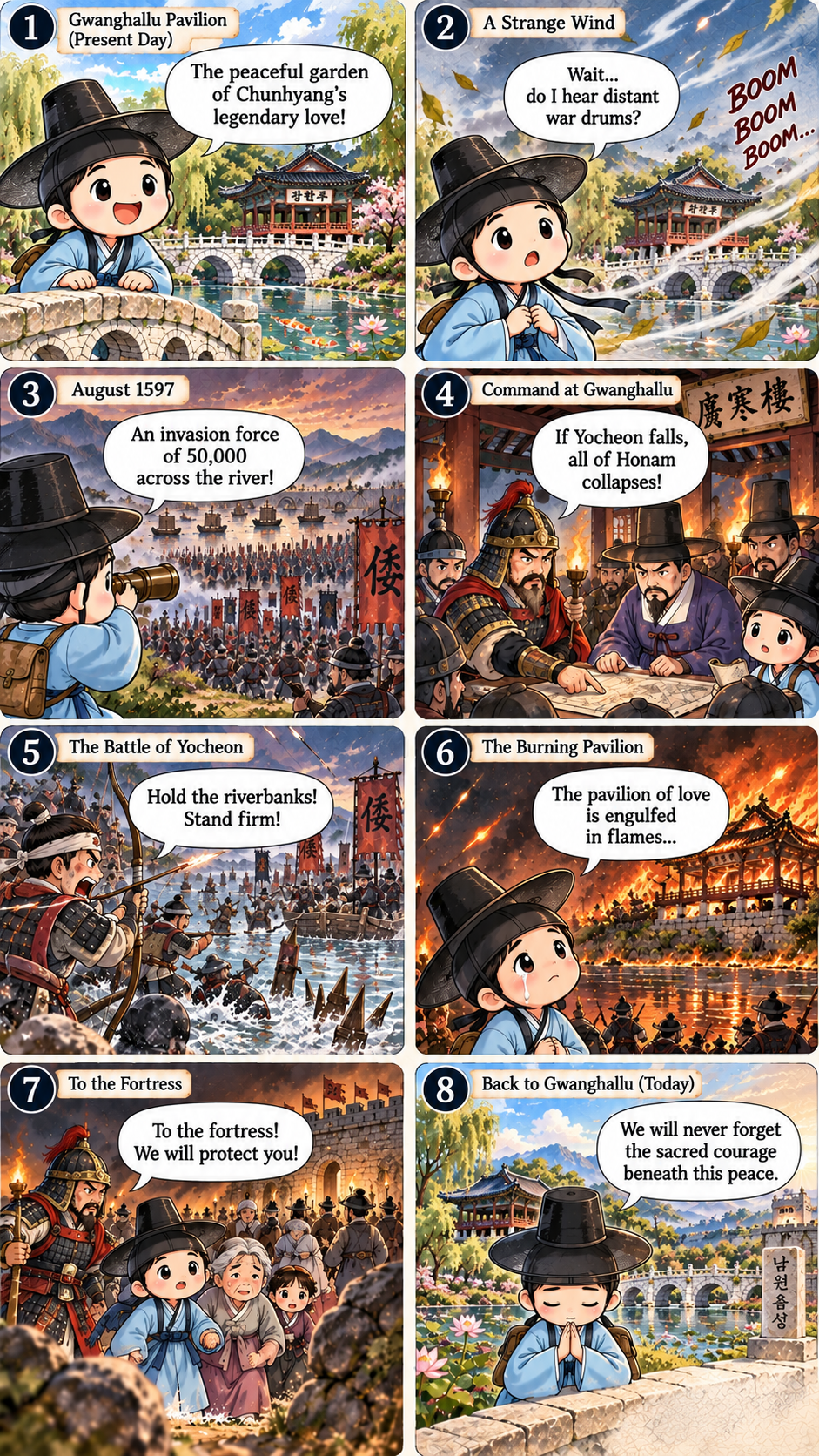
▲ [8-Panel Comic Reel] Prologue: From the Pavilion of Love to War Headquarters — The Tragedy of Yocheon River
6. Strategic Battlefield Transition & Deep Spatial Tour Guide
From the Outer River Line to the Besieged Flatland Fortress — The Strategic Meaning of the 500-Meter Pilgrimage
Having explored Gwanghallu and the Yocheon waterfront, travelers must now leave the first defensive barrier behind and proceed toward the primary theater of encirclement and sacrifice: [Chapter 1: The Bloodstained Namwon Fortress].
- Walking Itinerary (500 Meters Northward, 7–8 Minutes):
Exit through the North Gate of Gwanghalluwon (near Wanwoljeong Pavilion) and walk straight north along the historic civic thoroughfare connecting the old administrative center (present-day downtown corridor). Within 500 meters, the restored granite ramparts and earthen embankments of Namwon Fortress will rise before you. - Tactical Continuity & Narrative Inevitability:
Why must a historical pilgrimage transition immediately from Gwanghallu to Namwon Fortress? In the military chronology of August 1597, the fight along Yocheon was an outer screening action. Once the 56,000-strong Japanese vanguard dammed the river and torched the surrounding suburbs, the entire population—soldiers, allied cavalry, monks, women, and children—was driven northward into the square flatland walls of Namwon Fortress. By walking this exact 500-meter path, the modern visitor retraces the desperate, choked retreat of August 13, experiencing firsthand the transition from open riverbank warfare to claustrophobic siege entrapment. - Traveler's Field Insight:
As you leave the open breezes of Yocheon and approach the stone battlements, imagine the terror of ten thousand souls pressing through the heavy wooden gates as the iron hinges slammed shut. That 500-meter walk represents the final boundary between tenuous hope and heroic martyrdom.
▲ [Next Battlefield Destination] Restored Ramparts of Namwon Fortress (Historic Site No. 298) Encountered at the End of the 500-Meter Pilgrimage — The very ground where 10,000 soldiers and civilians retreating from Gwanghallu and Yocheon mounted their desperate four-day last stand against 56,000 Japanese invaders. Reconstructed upon authentic excavated foundations, this fortress wall serves as the poignant threshold to the epic siege detailed in the following chapter.


